Explore events related to the Republic of Cascadia here! Have an event you’d like to share? Contact us!
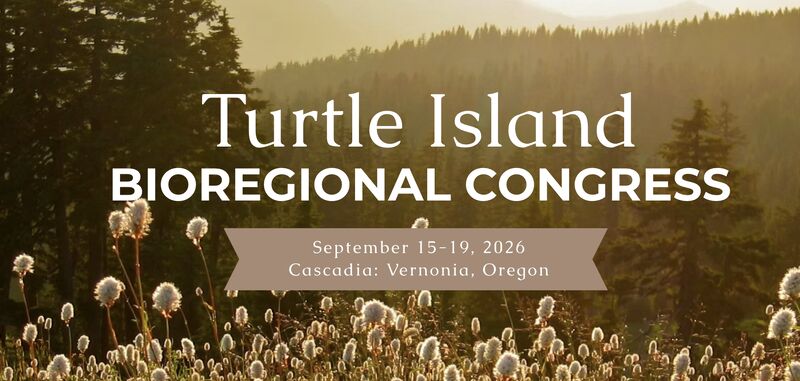
2026 Turtle Island Bioregional Congress 11
The Turtle Island Bioregional Congress, scheduled for September 15–19, 2026, near Vernonia, Oregon, brings together activists, educators, scientists, Indigenous leaders, and community organizers who share a simple premise: political borders often ignore ecological reality. Rivers do not stop at state lines. Forests do not care about international treaties. Salmon certainly never asked permission from immigration officials before swimming from the ocean into inland rivers.
The Congress focuses on bioregionalism, a philosophy that suggests communities should organize themselves according to natural ecosystems rather than arbitrary political boundaries. In other words, governance might make more sense if it followed watersheds, mountain ranges, forests, and coastlines. Radical idea, apparently. Humans tend to enjoy drawing straight lines on maps because it makes us feel organized, even when those lines cut straight through rivers, forests, and entire cultural regions.
The phrase Turtle Island anchors the event in Indigenous perspectives that have long understood this ecological relationship. In many Indigenous traditions, Turtle Island refers to North America as a living land supported by a great turtle. The story varies among cultures, but the symbolism is consistent: the land is alive, interconnected, and worthy of respect. The Congress draws heavily from that worldview while also incorporating modern ecological science, environmental activism, and community organizing.
Participants at the Turtle Island Bioregional Congress are not gathering just to sit in a circle and admire the trees, although there will probably be plenty of that too. The goal is practical collaboration. Workshops and discussions will explore topics such as watershed restoration, regenerative agriculture, climate resilience, Indigenous sovereignty, and decentralized governance. If that sounds ambitious, that’s because it is. Large environmental problems tend to require large conversations.
One of the key themes of the Congress is regional cooperation. The Pacific Northwest, often referred to as Cascadia, is a good example of why bioregional thinking matters. The forests, rivers, and mountain ranges of Washington, Oregon, and British Columbia form a single ecological system despite being divided by an international border. When wildfires spread, salmon populations decline, or floods hit coastal communities, the consequences ripple across the entire region. The Turtle Island gathering encourages people to address those shared challenges collaboratively rather than pretending that political boundaries somehow solve them.
Another major focus is community resilience. Climate change has already begun reshaping ecosystems across Turtle Island, from droughts in the Southwest to flooding in the Pacific Northwest. The Congress aims to connect grassroots organizers with scientists, land stewards, and policy thinkers who are experimenting with local solutions. The idea is that real adaptation often happens at the community level, where people actually live with the land rather than governing it from distant capitals.
There is also a cultural dimension to the event. Art, storytelling, music, and ceremony play a role in many bioregional gatherings. The reason is simple. Ecological awareness is not just a technical problem. It is also a cultural shift. People protect what they feel connected to, and stories have always been one of the most powerful ways to build that connection.
Critics sometimes dismiss events like the Turtle Island Bioregional Congress as idealistic or impractical. That criticism misses the point. Many of the systems currently governing environmental policy were designed centuries ago when ecosystems were less stressed and populations were smaller. Trying to solve modern ecological crises with outdated frameworks can feel like repairing a wildfire with a garden hose.
The Congress does not claim to have all the answers. What it does offer is something increasingly rare in modern politics: a place where people can step outside rigid ideological boxes and think about the land itself as the organizing principle.
In a world that often treats nature as a resource to be consumed, the concept of Turtle Island offers a different story. It suggests that the land is not just where we live. It is something we belong to. Sometimes humans need a gathering like this to remember that simple fact. Whether the rest of society is ready to listen is another matter entirely.