Table of Contents
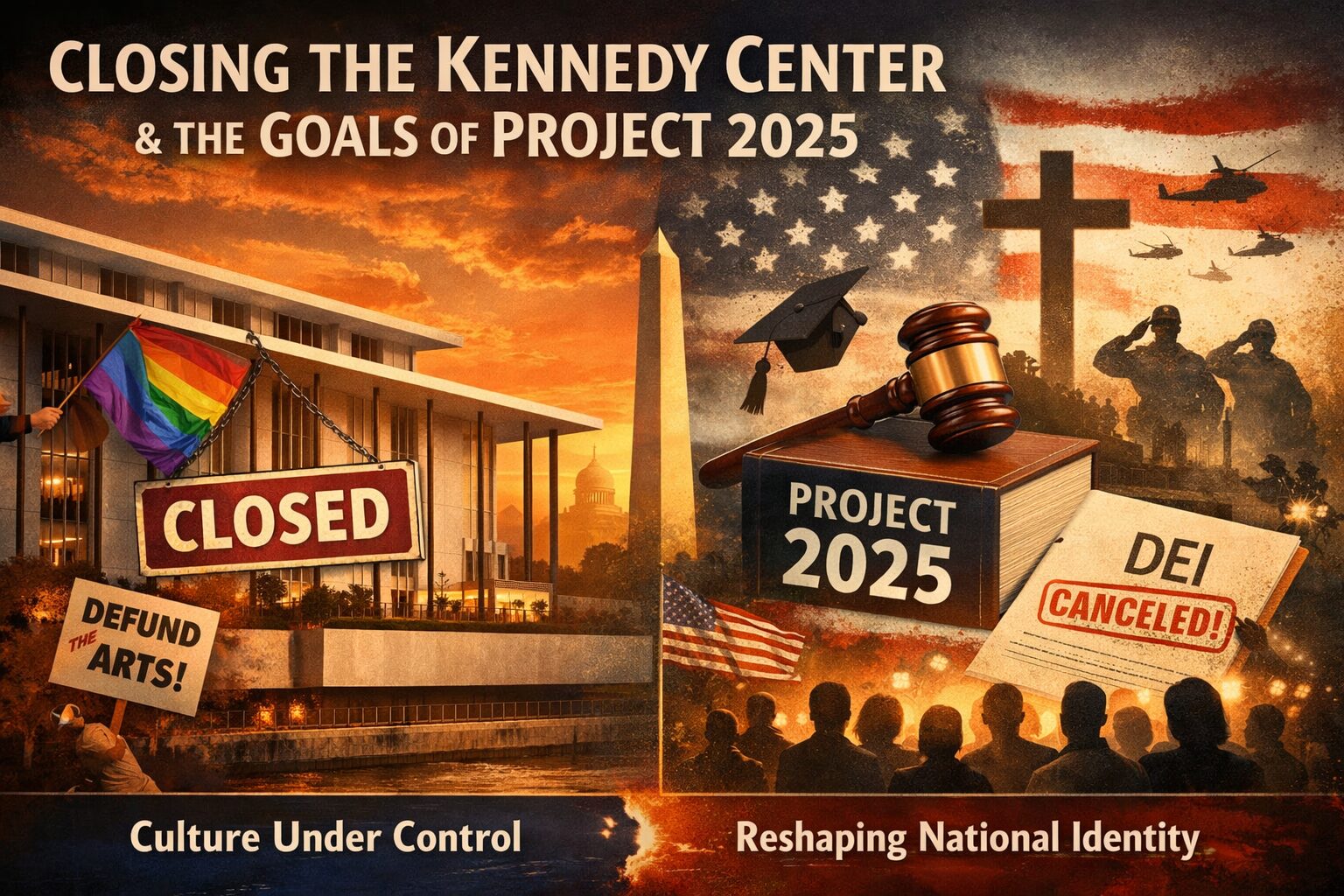
When you hear about the closing of the Kennedy Center, it can sound like a narrow story about arts funding, renovations, or administrative reshuffling. Or just Trump being Trump. That surface explanation misses the bigger picture. When you place the Kennedy Center’s closure alongside the stated goals of Project 2025, a much clearer pattern emerges. This is not just about a building going dark. It is about how political power is being used to reshape national culture, memory, and identity.
For people in the Republic of Cascadia, this matters deeply. Cascadia has long positioned itself as a region that values pluralism, creative expression, and cultural self-determination. Understanding how federal cultural policy is being reoriented helps you see what is at stake, not just in Washington, D.C., but in every region that relies on arts, public culture, and civic storytelling.
Project 2025 and the Politics of Culture
Project 2025 is a comprehensive plan designed to reorganize the federal government under a totalitarian conservative administration. While much attention has been paid to its proposals around executive power and civil service reform, its cultural agenda is just as significant. This is because the culture shapes the politics of a nation. There’s a reason for the culture wars of the Gang of Pedophiles. The project explicitly frames culture as a battleground. It treats arts, education, museums, and public institutions as vehicles that shape values, norms, and national identity.
From that perspective, culture is not neutral. It is something to be disciplined, redirected, or defunded if it does not align with the Turd Reich’s preferred ideological framework. Project 2025 repeatedly emphasizes the elimination of diversity, equity, and inclusion initiatives, the narrowing of acceptable narratives about American history, and the rollback of federal support for institutions seen as promoting “progressive” values.
The arts are not an afterthought in this framework. They are a strategic target.
The Kennedy Center as a National Symbol
The Kennedy Center is not just another performing arts venue. It is the nation’s premier cultural institution, federally chartered and partially funded by the U.S. government. Its programming has historically reflected a wide spectrum of American and global artistic expression, including work that explores race, gender, sexuality, immigration, dissent, and social change. In other words, it has always supported diversity, equity, and inclusion.
That breadth is precisely why the Kennedy Center matters to the MAGA Nazi pedophile protectors in the context of Project 2025. National cultural institutions do not just entertain. They legitimize ideas. They signal whose stories are worthy of public recognition and whose voices belong in the national conversation.
When leadership changes, programming is curtailed, or operations are suspended, the effect is not neutral. It reshapes what the federal government endorses as “official” culture.
Kennedy Center Closure as Cultural Alignment
Although Project 2025 does not explicitly list the closure of the Kennedy Center as a policy goal, the logic behind the move aligns closely with its broader objectives. Closing or sidelining a major cultural institution accomplishes several things that Project 2025 openly advocates.
First, it reduces the visibility of artistic work that challenges traditional or nationalist narratives. Second, it weakens institutional platforms that amplify marginalized voices. Third, it sends a clear signal to other federally connected arts organizations about what kinds of programming are politically safe.
In this sense, the Kennedy Center’s closure functions as a form of cultural discipline. It demonstrates how executive power can be used to reshape culture without banning speech outright. Instead of censorship by law, you see control seeping in through funding decisions, leadership appointments, and operational authority.
Cultural Centralization and Executive Power
Another core goal of Project 2025 is the centralization of authority within the executive branch. This is the path to dictatorship spelled out in Project 2025. Cultural institutions tied to federal oversight are especially vulnerable to this shift. When cultural leadership is no longer insulated from political loyalty tests, artistic independence erodes.
The Kennedy Center’s situation illustrates how this process works in practice. Changes in governance lead to changes in programming. Changes in programming lead to changes in public culture. Over time, this creates a narrower cultural landscape that reflects political priorities rather than artistic or civic ones.
For Cascadia, which often stands apart from dominant national political currents, this centralization poses a real risk. Federal cultural policy has ripple effects. When national institutions are reshaped, regional funding priorities, grant criteria, and cultural norms tend to follow.
Why This Matters to Cascadia
Cascadia’s identity has always been tied to creativity, environmental consciousness, and social experimentation. Artists, writers, musicians, and performers play a central role in shaping how you understand community and belonging. When national institutions like the Kennedy Center are constrained, it sets precedents that can trickle down to state and regional levels.
If culture becomes something to be controlled rather than cultivated, the space for dissent, imagination, and collective healing shrinks. You are left with culture as branding rather than culture as dialogue.
Understanding the Kennedy Center closure through the lens of Project 2025 helps you see that this is not an isolated administrative decision. It is part of a broader effort to redefine whose values count and which stories are allowed to shape the public square. If that doesn’t scare you, you’re not paying attention.
Looking Ahead
For the Republic of Cascadia, the lesson is clarity. Cultural institutions are not merely decorative. They are political, whether acknowledged or not. The closing of the Kennedy Center reveals how cultural power can be quietly restructured to serve ideological ends.
If Cascadia is serious about preserving cultural plurality and creative freedom, it means paying attention to these signals and resisting the normalization of cultural shutdowns as mere budgetary or managerial choices. Culture shapes reality. Whoever controls it controls far more than art.
Like and Share!
Love Cascadia? So do we! Like, comment, and connect with your community—then catch all our videos on YouTube: https://www.youtube.com/@republicofcascadia
You can also subscribe to our monthly newsletter using the button below!